Caspian Navigation

Beauty & Personal Care

High SKU counts, complex ingredient sourcing, and international distribution.

Beauty and personal care brands import at high frequency across dozens of ingredient categories, packaging types, and finished product lines. The duty recovery opportunity in this sector is real and growing. Most brands haven't looked at it because their customs broker never told them it was there.

Are you overpaying?

The Tariff Landscape for Beauty & Personal Care

Beauty and personal care imports span a wide range of HTS chapters: cosmetics and toiletries under Chapter 33, essential oils and aroma compounds under Chapter 33, packaging under Chapters 39 and 76, specialty ingredients crossing the boundary between Chapters 28, 29, and 30. Each chapter carries different duty rates, different Section 301 exposure for Chinese-origin goods, and different IEEPA applicability. For brands sourcing ingredients and packaging from Asia, the tariff bill has grown materially since 2018 and compounded with each successive trade action.

The brands recovering duty most effectively aren't the largest ones. They're the ones who recognized that their international wholesale distribution, their DTC export volumes, and their return flows from international retailers all create drawback eligibility on the duties paid at import. The math works at smaller scale than most brands assume. Caspian shows you the number before you commit to anything.


Pink perfume bottle on reflective mirrored cube beside a glass pyramid and reflective triangular prism.

Recovery Opportunities

Manufacturing Drawback on Exported Finished Products

Beauty brands that import ingredients and formulate them into finished products sold internationally qualify for manufacturing drawback on the duties paid at import. This applies to brands selling through international retail, foreign distributors, or direct cross-border DTC. Given the high ingredient-to-retail-price ratio in prestige beauty, recovery amounts are often larger than brands expect. Caspian maps every eligible input against your export history and files automatically.

Unused Merchandise Drawback on Returned & Unsold Inventory

Beauty products returned from international retailers, redirected from export markets, or liquidated through international channels after a seasonal reset generate unused merchandise drawback eligibility. High SKU counts and short product cycles (common in beauty) mean return and redirect volumes are significant. Caspian tracks every eligible return at the SKU level and files claims that would otherwise lapse unclaimed.

Section 301 Overpayments on Ingredients & Packaging

Specialty ingredients, botanical extracts, and packaging components sourced from China carry Section 301 exposure under List 3 and List 4A. Misclassification of cosmetic ingredients between Chapter 33 and Chapters 28 or 29 is common in high-SKU beauty operations and the duty rate difference between chapters can be substantial. Caspian audits every entry against the current tariff schedule and recovers overpayments through post-summary corrections within the liquidation window.

Beauty & Personal Care

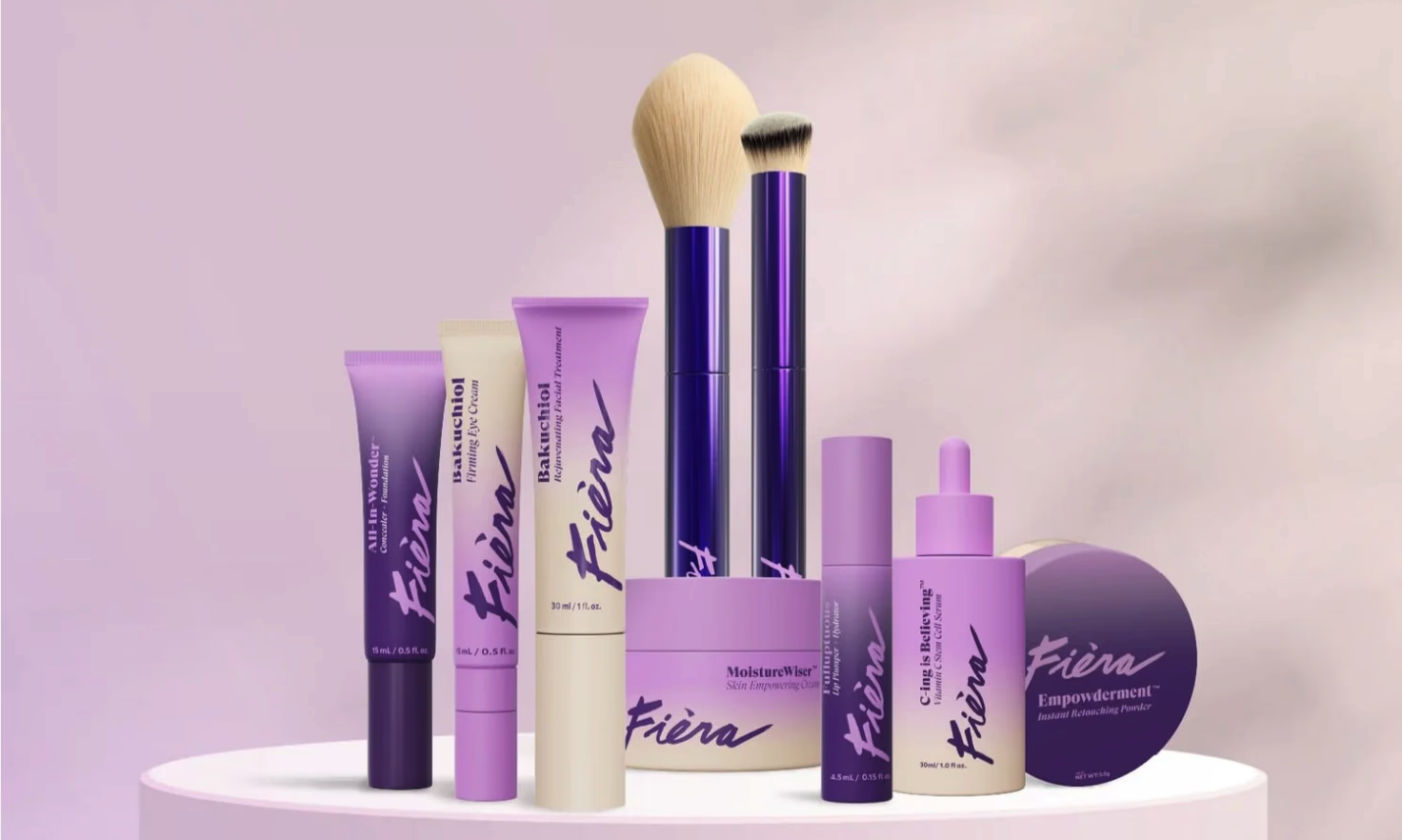
Brushing Away Complexity: Fièra Simplifies Packaging Drawback

Fiera Cosmetics creates premium beauty products for a global market, manufacturing and packaging finished goods in the US using imported components.

Read Fiéra Case Study
Fiera Cosmetics duty drawback case study

Don't Get Caught Off Guard

Beauty & Personal Care Compliance Risks

Beauty and personal care imports are subject to FDA cosmetic regulation in addition to CBP customs requirements, and the two frameworks don't always point in the same direction. Brands that treat import compliance as purely a logistics function are missing the regulatory layer that determines whether a product can be sold at all.

FDA Cosmetic Registration and MoCRA Compliance

The Modernization of Cosmetics Regulation Act of 2022 requires foreign manufacturers shipping to US beauty importers to register with FDA, and importers are responsible for ensuring their suppliers have done so. CBP is coordinating with FDA on MoCRA compliance at entry. Brands that haven't audited their supplier registration status are carrying admissibility risk on every shipment from an unregistered facility.

HTS Misclassification Across Cosmetic & Chemical Chapters

The boundary between Chapter 33 (cosmetics), Chapter 29 (organic chemicals), and Chapter 30 (pharmaceuticals) is regularly contested for beauty ingredients. Specialty actives, peptides, and botanical extracts often sit at classification crossroads where duty rates diverge meaningfully. In high-SKU beauty operations, those errors accumulate quietly across hundreds of entries until an audit surfaces them all at once.

Country of Origin on Contract-Manufactured Products

Beauty brands using contract manufacturers that blend ingredients from multiple countries face COO questions their manufacturer's documentation may not resolve correctly. CBP's substantial transformation analysis applies at the formulation stage, and brands that moved to Southeast Asian contract manufacturers to avoid China-origin Section 301 exposure may find their COO declarations challenged on import, creating the same tariff liability they were trying to avoid, with added penalty risk for incorrect declaration.

No Surprises

Transparent Pricing

We offer clear, project-based pricing for all audit and compliance services. Get a fixed quote upfront, with no surprises.

start trade audit

Frequently Asked Questions

Why is beauty & personal care a growing drawback opportunity?
Expandable icon for frequently asked question section

Beauty and personal care brands have characteristics that make drawback increasingly relevant: complex international ingredient sourcing, high SKU counts driven by frequent product launches, and growing international distribution as DTC and prestige beauty brands expand globally. Each of these increases the volume of imports that ultimately leave the country again, either as finished goods or as components in exported products.

What drawback programs apply to beauty importers?
Expandable icon for frequently asked question section

Manufacturing Drawback applies to imported ingredients, fragrances, and packaging components used in domestically formulated products that are exported. Unused Merchandise Drawback applies to imported finished goods re-exported without sale. Rejected Merchandise Drawback covers returns. Substitution Drawback is particularly useful for commodity ingredients sourced from multiple international suppliers.

How do FDA regulations interact with drawback?
Expandable icon for frequently asked question section

Beauty products are subject to FDA cosmetic regulations and, for products with drug claims such as sunscreens and anti-acne treatments, FDA drug regulations. These don't affect drawback eligibility, which is a CBP function, but the import documentation may need to satisfy FDA labeling and ingredient disclosure requirements alongside CBP duty calculations. Caspian's Trade Audit operates on the CBP side.

What about high-SKU prestige and indie beauty brands?
Expandable icon for frequently asked question section

High SKU counts are one of the historical reasons beauty brands have under-filed drawback. The reconciliation work, matching imports to exports at the SKU level across thousands of products, was prohibitive when done manually. Caspian's Dynamic Product Catalog handles SKU-level reconciliation automatically, making drawback feasible for brands with rapidly evolving product lines.

How does HTS classification affect beauty imports?
Expandable icon for frequently asked question section

Beauty product HTS codes span several chapters, including Chapter 33 (essential oils, perfumery, cosmetics), Chapter 34 (soap and cleansing preparations), and various chapters for packaging components. Classification is sometimes ambiguous, with products falling between cosmetic, soap, and drug categories, and small classification differences can mean meaningful duty rate differences.  Caspian's Classification work assigns correct codes. Trade Audit recovers duty overpaid on past misclassifications.

Are international DTC and travel retail eligible for drawback?
Expandable icon for frequently asked question section

Yes. Beauty brands selling internationally through DTC channels, marketplaces, or travel retail (duty-free) have export transactions that support drawback claims on the underlying imports. Travel retail in particular can be substantial for prestige beauty brands with airport and cruise distribution. Caspian's platform integrates with major fulfillment and retail systems to capture these export streams.